Don't Rebuild Your SaaS. Reinvent It.
Replacing standard SaaS with a custom build is a huge opportunity. But the biggest risk isn't technical. It's that you rebuild the exact thing you were trying to escape.
So you've decided to build instead of buy. Good. You're done paying for 100 features to use 20, done bending your process around someone else's product. You want software that is yours.
Then reality kicks in. And it's messier than the business case suggested.
Reality one: people hate change
The first wall you hit isn't code. It's people.
Your team has muscle memory. They know exactly which three tabs to open, in which order, to get through their Tuesday. That clunky SaaS tool they complain about every single day? They also, secretly, know it cold. And the moment you propose replacing it, those same complaints turn into "but it works fine, actually".
This isn't stupidity. It's inertia. Familiar friction feels safer than unfamiliar ease. Underestimate this and your beautiful new tool becomes shelfware, no matter how good it is.
Reality two: you can't see past the old software
Here's the trap nobody warns you about, and it's the dangerous one.
When you set out to replace a tool, your brain anchors to that tool. You start listing its screens, its fields, its buttons. You write requirements that read like a feature parity checklist. Before you know it, you're not building something better. You're building a slightly nicer replica of the thing you wanted to escape.
And a replica is the worst possible outcome. You've taken on all the cost and risk of building, and all you got was the same workflow with a different logo. You inherited someone else's assumptions about how work should happen, assumptions made years ago, by people who never met your business.
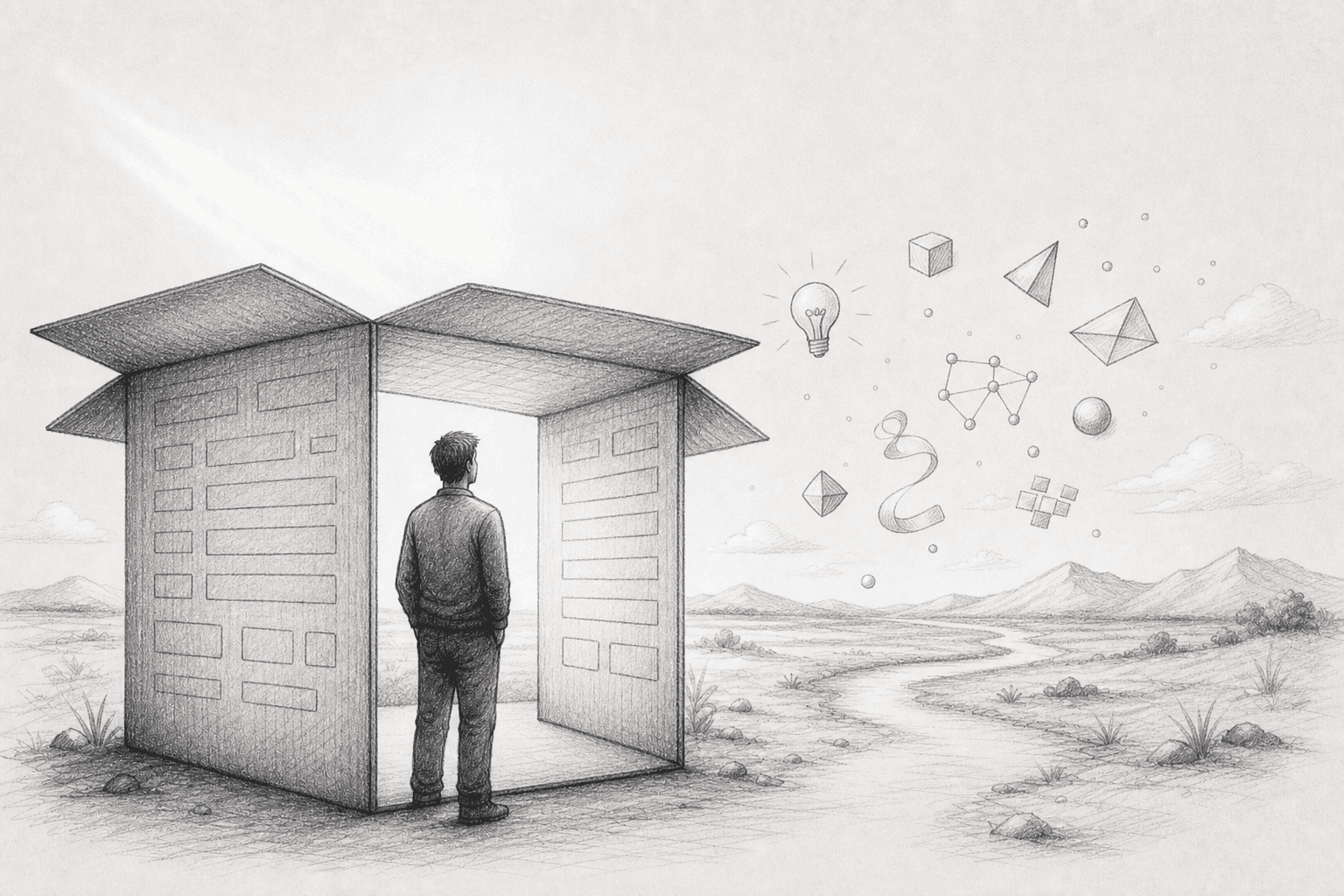
The old software isn't just a tool. It's a box. And it's really, really hard to think outside of it, precisely because you've been living inside it for years.
The opportunity you're actually holding
Stop asking "how do we rebuild this?" Start asking "what would make our people's lives genuinely better?"
That's a completely different question. It doesn't start with screens and forms. It starts with the outcome people actually want, and works backwards.
The old box assumes a human sits down, opens a form, and types in data. But why? In a lot of cases the data already exists somewhere. The system could fetch it, infer it, or simply ask once and never again. The best software you can build right now isn't software people are forced to use. It's software people opt in to, because it quietly makes their day shorter and their work better.
- Don't digitize the form. Eliminate it. If a human is filling in fields a machine could fill, you've already lost.
- Don't replicate the workflow. Question it. Half the steps exist because the old tool needed them, not because your business does.
- Don't build for compliance. Build for delight. People route around tools they hate and lean into tools they love. Adoption is a design problem, not a mandate.
This is exactly where steering matters. AI will happily, instantly, build you a flawless replica of your old SaaS. That's the seductive part.
It's never been easier to build the wrong thing fast.
The hardest part has not changed
Here's the uncomfortable truth at the end of all this optimism.
AI has crushed the cost of writing code. It has not crushed the cost of imagination. Generating ten variations of a screen is trivial now. Knowing that the screen shouldn't exist at all? That still takes a human who can step back, ignore the box, and picture something that doesn't exist yet.
So yes, replacing standard software with a custom build is more achievable than ever. The pros are real: ownership, fit, speed, focus. The cons are real too: change resistance, and the constant gravitational pull back toward the familiar.
But the deciding factor was never the technology. Even with all the AI in the world helping us build, thinking outside of the box is truly the hardest thing.
That's the work. That's also where all the value is.